
Home Blog

Example Of Adverb Of Time – Meaning And 40 Examples Of Adverb Of Time

Example Of Adverb Of Time – Meaning And 40 Examples Of Adverb Of Time

Adverbs help you stay current and know how to refer to past and future events. That is why you should know what an adverb of time is, how it is used, and some examples.

Knowing when something is happening, has happened, or will happen holds meaning for human beings. Adverbs of time can help specify exactly when an action takes place.

Learn all about how adverbs of time are used, their meaning and definition in this. In English, adverbs of time help us organise and communicate these details clearly.

Meaning Of Adverb Of Time 

According to the Cambridge Dictionary, an adverb of time “can tell us about when an action happens, (now, soon, etc.) or how frequently an action happens (usually, always, etc.)”

An adverb of time is an adverb that can be used in a sentence to depict when an action mentioned in the sentence is taking place.

Examples Of Adverbs Of Time 

If you don’t know, there are many examples of Adverbs of time, but we’ll only list 40 for you.

Some of the examples include the following:

  1. Soon
  2. Before
  3. After
  4. Then
  5. Daily
  6. Weekly
  7. Monthly
  8. Quarterly
  9. Annually
  10. Yesterday
  11. Still
  12. Tomorrow
  13. Last week
  14. Currently
  15. Tonight
  16. Yet
  17. Afterward
  18. Recently
  19. Everyday
  20. Last week
  21. Next
  22. Eventually
  23. Previously
  24. Instantly
  25. Long ago
  26. Often
  27. At the moment
  28. Nowadays
  29. Now
  30. Rarely
  31. Later
  32. In the past
  33. Thereafter
  34. At once
  35. Day after tomorrow
  36. Earlier
  37. At last
  38. Momentarily
  39. Immediately
  40. Never

Functions Of Adverbs Of Time

You may not know, but adverbs do have functions in English, and we will look into them now. Some of the functions of the Adverb of time include the following:

  1. Tells when an action happens
  2. Describe the frequency of an action
  3. Indicate the duration of an action
  4. Providing context for different tenses
  5. Modifying verbs, adjectives, or other adverbs

Let’s get started.

  1. Adverb of Time Tells When an action happens: These adverbs specify the exact or general time of an event.
    • Specific time: Yesterday, now, tomorrow.
    • General time: Sometimes, often, never.
  2. Frequency of an action: They indicate how often an action takes place.
    • Yearly, quarterly, monthly, weekly.
    • Always, regularly, rarely.
  3. Duration of an action: They show how long an action continues.
    • For two weeks, since 2009.
    • Immediately, recently, permanently.
  4. Providing context for different tenses: They help clarify various verb forms and tenses.
    • For example, before or after could be used with different tenses to show temporal relationships.
  5. Modifying verbs, adjectives, or other adverbs: They modify other words in the sentence to provide more detail about the timing of an action.
    • Example: “She will arrive later” (modifies the verb “will arrive”).
    • Example: “He is now ready” (modifies the adjective “ready”). 

Placement Of Adverbs Of Time

Adverbs of time can appear in different positions in a sentence depending on what is being emphasised:

  • At the beginning: Tomorrow, we have a big test. (emphasises time)
  • At the end: We have a big test tomorrow. (most common position)
  • Between the subject and verb: She often reads before bed. (for frequency adverbs)

Conclusion 

Having a command of the English figures of speech and how to use them properly can help you in your learning journey. Most times, you may not know certain things that concern timing, which is why you need to understand your adverb of time well.

What is an Adverb of time, its examples, and other possible questions which you might have are covered in this post. Go through this post carefully and be sure to improve your command of adverbs.

We hope this post was helpful for you.

Example Of The Longest Rivers In Africa – Top 6 Longest Rivers In Africa

0

Example Of The Longest Rivers In Africa – Top 6 Longest Rivers In Africa

Even Africans sometimes do not know some of the rivers they have not to talk of the longest rivers in Africa. If you are an african you should be acqainted with some of the prominent long rivers there is in Africa as well as their locations.

Longest Rivers In Africa

Here we have prepared a list of the top longest rivers in Africa and where they are located. They include the following:

  1. Nile River – 6,650 km
  2. Congo River – 4,700 km
  3. Niger River – 4,180 km
  4. Zambezi River – 2,574 km
  5. Ubangi-Uele Rivers – 2,270 km
  6. Orange River – 2,200 km

Let’s get started.

1. Nile River – 6,650 km (4,132 miles): The Nile River is not only the longest river in Africa but also in the world.

It flows South to North, beginning near Lake Victoria and emptying into the Mediterranean Sea – crossing eleven East African countries en route (Burundi, Tanzania, Rwanda, the Democratic Republic of the Congo, Kenya, Uganda, Sudan, Ethiopia, South Sudan, and Egypt) and discharging an average of 99,941 cubic feet of water per second.

A benevolent source of fertile soil that rebels against the surrounding sands, and a crucial trade channel, the Nile famously allowed the ancient Egyptians to establish one of the earliest advanced civilizations.

2. Congo River – 4,700 km (2,920 miles): The second-longest river in Africa is Congo River formerly known as the Zaire River, is the ninth-longest in the world, and the deepest river on the planet, both in terms of maximum and average depth.

Its point of origin can be considered to be in the highlands of Northeastern Zambia and/or the Katanga Plateau in the Southeastern corner of the Democratic Republic of the Congo.

In either case, the river flows in a counter-clockwise arc, twice crossing the equator, and discharging 1,454,964 cubic feet of water per second on its way to the Atlantic Ocean at a seaport called Banana (or Banane) in the Democratic Republic of the Congo.

The curious shape and direction of flow (the Niger begins near the Atlantic Ocean but flows away from it and into the Sahara Desert) baffled early explorers but is now generally thought to be the product of two ancient rivers joining together.

4. Zambezi River – 2,574 km (1,599 miles): Zambezi river also know as the The “Great River” is a important source of life for iconic African animals as elephants, buffalo, hippos, antelope, and crocodiles, as well the human beings living between its humble origin in the uplands of Zambia, all the way to the Indian Ocean.

The Zambezi picks up steam as it chugs Eastward, providing abundant electricity for many of its basin communities. The Kariba Dam supplies power to Zambia and Zimbabwe, and the Cahora Bassa Dam lights up Mozambique and South Africa.

These are two of Africa’s largest hydroelectric projects. But Zambezi’s most notable feature is easily Victoria Falls (which also has a small power station).

5. Ubangi-Uele Rivers – 2,270 km (1,411 miles): Central Africa’s Ubangi River (or Oubangui) and Uele River round out the continent’s top five rivers. The confluence of the Dungu and Kibali rivers in the Democratic Republic of the Congo is where the Uele begins.

It then flows into the Ubangi (of which the Uele is the largest tributary) at the confluence of the Mbomou River, which defines part of the boundary between the Central African Republic and the Democratic Republic of the Congo.

Ubangi is not only a vital source of freshwater for all living things near its shores like many of the rivers on this list but a major vessel for everyday transportation for the people of this region.

6. Orange River – 2,200 km (1,367 miles): The Orange River, which got its name in 1779 from a Dutch official in reference to the Dutch Royal House of Orange, starts its journey in the Drakensberg Mountains and travels West to the South Atlantic Ocean, defining a large portion of the boundary between Namibia and South Africa.

This waterway also separates distinct environments.

Example Of MTN Data Plans – Cheapest MTN Data Tariff Plans In 2025 To Try

0

Example Of MTN Data Plans – Cheapest MTN Data Tariff Plans In 2025 To Try

As a Nigerian using MTN, you’ll agree with me that there are many affordable MTN Data plans available. And this has made MTN one of the most popular and widely used networks in Nigeria. If you use MTN, you would be interested in finding and jumping on the cheapest MTN data tariff plan. Who wouldn’t? Especially considering the long hours we spend on the internet.

 Since MTN users have to buy airtime and data, each tariff plan must be affordable so that anyone can access the internet.

Basically, data tariff plans can be regarded as bundles of services around internet service provision. They’re data packages in the form of daily, weekly or monthly subscriptions and may include other benefits. The data tariff plan lists different subscription packages and their respective costs.

Top Cheapest MTN Data Tariff Plans In 2025

Everyone loves cheap deals, even those who can afford to pay full price times ten! We’ve done our homework to help you and your business, and now present the best deals on the MTN network. See which of the top 5 cheapest MTN data tariff plans tallies with your data needs.

1. Daily Plan

  • 1GB Daily Plan (₦500): The 1.5 GB daily plan is a great value for anyone who just wants to surf the internet or needs emergency data.
  • 2.5GB Daily Plan (₦750): If you need more data for streaming or downloading, this plan is ideal.

2. 2-Day Plan

If you thought the daily tariff was cheap, wait till you explore the 2-Day plan. This plan gives you 48 hours of nonstop internet access. It has one bundle.

  • 3.2GB 2-Day Plan (₦1000): With 3.2GB of data, you’ll have enough for moderate to heavy usage, and it will last you for two days.
  • 2GB 2-Day Plan (₦750): This data plan offers 2 GB of data with a validity of 2 days.
  • 2.5GB 2-Day Plan (₦900): This gives you the same amount of data as the 2.5 GB daily plan, however, this lasts for two days. This plan is suitable for two people who want the 2.5 GB but need it for 2 days.

3. Weekly Plan

The weekly plan offers you a reasonable amount of data for browsing and medium downloads for 7 days.

  • 1.2GB 7-Day MTN Pulse Plan (₦700): This data plan is specifically for MTN Pulse subscribers.
  • 1.5GB 7-Day Plan (₦1000): This is a great option for people not on the MTN Pulse tariff who only need data for basic tasks.
  • 11GB Weekly Data Plan (₦3500): This data plan is ideal for heavy users or those who need data for multiple devices. With 11GB of data, you’ll have enough for a week’s worth of heavy usage.

4. Monthly Plan

  • 2GB Monthly Data Plan (₦1500): This data plan is suitable for you if you’re a light data user and you want a data plan that won’t expire in a day or two. This plan gives you 2GB of data to use for up to 30 days for just ₦1500.
  • 2GB Monthly Plan  (₦2000): You get 2.7GB for just ₦2000, with a 30-day validity period, so you don’t have to worry about it expiring if you don’t use data heavily.
  • 3GB Monthly Plan (₦2500): For just ₦2500, you’ll get 3.5GB of data valid for 1 month.
  • 7GB Monthly Plan (₦3500): This plan gives 7GB of data valid for one month, so you can surf your favourite sites and watch your favourite TV shows.
  • 10GB Monthly Plan (₦4500): If you’re on the heavy data usage side, this plan is for you. You get a massive 10GB of data for activities like streaming, downloading, gaming, and more for just ₦4500.

Benefits of the MTN Monthly Data Tariff Plan

  • Wide variety of options for any use case.
  • Relatively affordable.
  • A 30-day validity period.
  • You can roll over your remaining data to the next month by activating another monthly plan.
  • An excellent plan for both personal and/or business use.

How To Subscribe To MTN Data Plans

Here are a few ways you can subscribe to the MTN Data plans

1. USSD code:  Dial *312*1# or *904#, then follow the prompts to select your preferred data plan.

2. SMS: Send the bundle keyword via SMS to 312.

3. MyMTN app: You can download the MyMTN app from the Google Play Store or the App Store. Get registered with your phone number, and navigate to data plans to buy your preferred bundle

4. Third-party apps: There are many third-party apps where you can buy MTN data plans. You can buy them from your bank app or a trusted, reliable platform like Prestmit.

Factors To Consider When Choosing A Data Tariff Plan

It pays to consider a few things before activating any plan, especially if you want maximum value for your money. So, consider the following the next time you want to renew or change your MTN data tariff plans.

1. Data Usage: Have you ever checked your data usage history to know how much data you consume daily, weekly or monthly? Tracking how much time you spend online is crucial. That’s how you’ll find out your average daily/weekly/monthly data usage and choose a commensurate plan.

2. Validity Period: Before sending the shortcode, be sure the allocated data allowance will be sufficient for the validity period you’re choosing and won’t be wasted.

3. Budget: Before picking a plan that works for you, think about how much data you are willing to spend each day, then accumulate it over time to find a suitable data plan for yourself, your business, or your enterprise.

4. Bonus Offers: The other factors are super important, but who doesn’t like a good incentive here and there?MTN usually throws bonuses like talk time or extra data for specific social platforms (YouTube, Instagram, etc.)

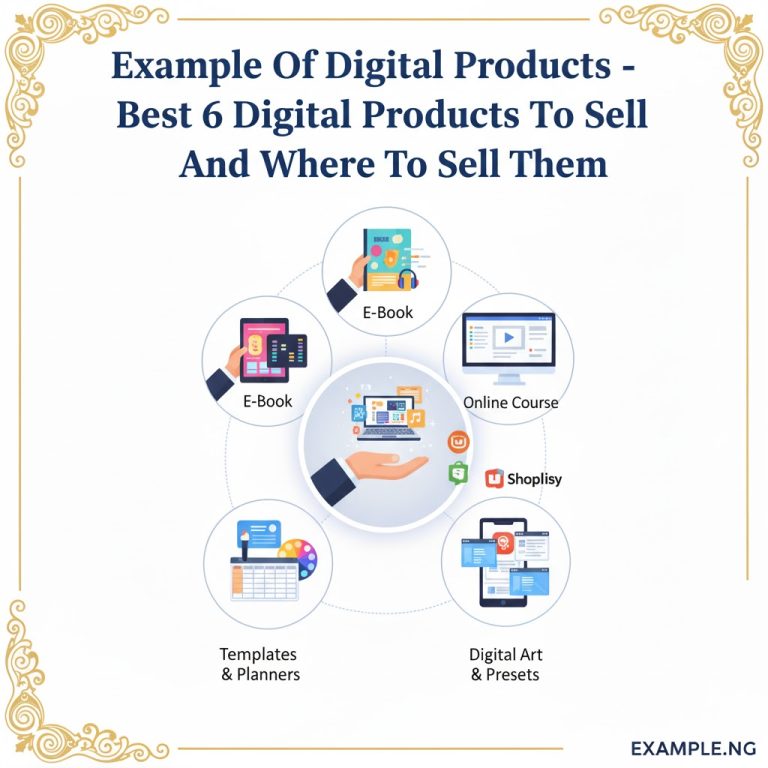
Example Of Digital Products – Best 6 Digital Products To Sell And Where To Sell Them

0

Example Of Digital Products – Best 6 Digital Products To Sell And Where To Sell Them

As an entrepreneur, you should aim to sell digital products, as they offer an amazing opportunity to trade without physical contact. Digital products provide powerful opportunities for entrepreneurs because they can be distributed instantly, require no inventory, and often generate passive income.

With a wide range of options, discovering the best digital products to sell can significantly enhance your online business’s profitability.

What Are Digital Products?

Digital products are intangible assets that are distributed online without physical interaction, such as eBooks, courses, software, graphics, digital booklets, and templates. They offer instant access upon purchase, adding convenience for users. Digital goods serve various needs, from personal development to creative design and business use.

Where To Sell Digital Products

Whatever the type of digital product you create, you need an easy-to-use platform to start selling. Popular marketplaces you can rely on include:

  • Etsy. Great for selling digital art, planners, and templates.
  • Gumroad. Ideal for creators who want a simple setup for digital downloads and memberships.
  • eBay. Suitable for reaching a large audience and selling digital downloads directly.
  • Creative Market. Suitable for digital assets like fonts, templates, and graphics.
  • Shopify. Excellent for those wanting a dedicated e-commerce site.
  • Teachable/Thinkific. Best for those selling online courses.

How To Sell Digital Products

Creating a product is the first step, but it’s not enough to sell digital products successfully. Here are some key steps to guide you:

  1. Identify Your Niche. Make sure there is demand for your product. Find out what needs it satisfies, and its utility.
  2. Analyse Competitors. Identify the unique features of your product based on the research findings.
  3. Choose Your Platform. Decide whether to sell on marketplaces like Etsy, Creative Market, or Gumroad, or directly through your own e-commerce site.
  4. Optimise Your Product Listings. Use clear, descriptive titles and keywords in product descriptions so potential buyers can find your products easily. Highlight the benefits and include attractive visuals.
  5. Set Pricing Strategically. Research similar products to price competitively. For high-value products like courses, consider tiered pricing for premium access.
  6. Promote Through Marketing. Utilise social media, email marketing, and influencer partnerships to reach your target audience.
  7. Offer Excellent Customer Support. Respond promptly to customer queries and add value by offering additional resources or product updates.

With these steps, you can start selling digital goods online effectively, reach a wider audience, and drive profitable results.

Best Digital Products To Sell

Your first step is to choose a niche and find popular digital products. To give you a better idea of the digital product market, here is the list of key players and their revenue in 2025:

  1. eBooks
  2. Online Courses and Workshops
  3. Stock Photography
  4. Music and Audio Tracks
  5. Digital Art Prints
  6. Social Media Templates 

Let’s get started.

1. eBooks: eBooks remain popular due to their versatility. Once written, eBooks can be sold repeatedly, which makes them one of the most profitable digital products to sell. eBooks on self-help, fitness, finance, and skills development tend to perform well on platforms like Amazon and Gumroad.

Pros:

  • Can cover a wide range of topics.
  • Low production cost with high scalability.
  • Passive income potential.

Cons:

  • Requires time to research and write.
  • High competition in popular niches.

2. Online Courses and Workshops: The demand for online courses is steadily growing as people seek continuous learning. With platforms like Udemy and Teachable, you can build and sell courses on various subjects, making them one of the best digital products to sell for passive income.

Pros:

  • High-value product, allowing for premium pricing.
  • Opportunities for recurring revenue with course updates.

Cons:

  • Requires a significant initial time investment.
  • May require ongoing support or updates.

3. Stock Photography: Photographers get to earn a lot of passive income through stock photos. Popular stock sites like Shutterstock allow you to reach a broad audience. Niche photos, like business or lifestyle, tend to be in high demand.

Pros:

  • Unlimited potential for passive income.
  • High demand from websites, bloggers, and marketers.

Cons:

  • Saturation in popular categories.
  • Requires photography skills and quality equipment.

4. Music and Audio Tracks: Musicians and audio engineers can create and sell royalty-free tracks and sound effects.

Pros:

  • High potential for passive income through royalty-free sales.
  • Appeals to a wide range of content creators.

Cons:

  • Requires musical expertise.
  • Competition in popular music genres.

5. Digital Art Prints: Digital art is ideal for artists looking to monetise their creations. Selling digital products is a profitable way to make money online because buyers love having instant downloads they can print and frame on sites like Etsy.

Pros:

  • Highly creative and customizable.
  • No need for physical inventory.

Cons:

  • Easy to copy, so branding is essential.
  • High competition on platforms like Etsy.

6. Social Media Templates: Because brands seek constant visuals for social media, templates are among the best digital products to sell. Tools like Canva make it easy to create customizable templates that sell well on platforms like Etsy.

Pros:

  • In-demand from businesses and influencers.
  • Helps customers save time with pre-made designs.

Cons:

  • Requires design knowledge.
  • Saturated market; need to create unique offerings.

Conclusion

The digital space presents you with countless opportunities, whether you’re interested in creating content, designing assets, or creating practical tools. The online business space is indeed profitable, as you can sell a range of things from eBooks and courses to social media templates and wellness content.

Before choosing the best digital products to sell, consider your skills, interests, and your target audience’s needs. Focus on in-demand digital products to build a sustainable, successful digital business.

We hope this content was helpful.

Examples Of Collective Nouns – Meaning And 80 Examples Of Collective Nouns For Animals You Should Know

Examples Of Collective Nouns – Meaning And 80 Examples Of Collective Nouns For Animals You Should Know

Most people find the English language complex and difficult to grasp, especially when they do not know what collective nouns are or their examples.

The English language is a unifying language that you should master and be conversant with, using words correctly and knowing what they mean, including collective nouns.

As simple as a noun can be, there are parts of a noun which may seem obscure to you because you do not have adequate knowledge of them, but not to worry, we will look into what collective nouns are and some examples for you.

What Is A Collective Noun?

A collective noun is used to present a group or collection of people, animals, or objects considered as a single whole.

Collective nouns help present group as a singular unit instead of listing each item or individual in a group, a collective noun provides a shortcut for referring to the entire group in a single term.

Key Characteristics Of Collective Nouns

Here are some key things to note about collective nouns. They include the following:

  • Singular in Form, Dual in Function: While collective nouns are grammatically singular, they can take singular or plural verbs based on context.
  • Used in Both Formal and Informal Settings: They are common in academic writing, spoken English, fiction, journalism, and classroom instruction.
  • Improve Language Economy: They make sentences shorter without losing meaning.
  • Aid in Visualisation: Words like “a flock of birds” paint a more vivid picture than generic alternatives.

Examples Of Collective Nouns For Animals 

Here are some of the collective nouns that can be attributed to various animals. In case you’ve been wondering we have them listed out for you. They include the following.

  1. Alligators — a congregation
  2. Antelope — a herd
  3. Ants — a swarm
  4. Apes — a shrewdness
  5. Bats — a colony, cloud or camp
  6. Bears — a sloth or sleuth
  7. Bees — a swarm
  8. Buffalo — a herd, gang, or obstinacy
  9. Camels — a caravan
  10. Cats — a clowder or glaring (adults), a litter or kindle (kittens), or a destruction (wild cats)
  11. Cheetahs — a coalition
  12. Chickens — a flock, brood, clutch, or peep
  13. Cobras — a quiver
  14. Cows — a herd
  15. Crabs — a cast
  16. Crocodiles — a bask
  17. Crows — a murder
  18. Deer — a mob
  19. Dogs — a pack (adults) or litter (puppies)
  20. Dolphins — a herd, pod, or school
  21. Donkeys — a drove
  22. Doves — a dole
  23. Ducks — a paddling or raft
  24. Eagles — a convocation
  25. Elephants — a parade
  26. Elk — a gang or a herd
  27. Falcons — a cast
  28. Ferrets — a business
  29. Fish — a school
  30. Flamingos — a stand
  31. Foxes — a skulk or leash
  32. Frogs — an army
  33. Giraffes — a tower
  34. Goats — a flock or trip
  35. Gorillas — a band
  36. Guinea Pigs — a herd or muddle
  37. Hippopotami — a bloat
  38. Horses — A team, rag (colts), or string (ponies)
  39. Hyenas — a cackle
  40. Insects — a cloud or swarm
  41. Jaguars — a shadow
  42. Jellyfish — a smack
  43. Kangaroos — a troop or mob
  44. Lemurs — a conspiracy
  45. Leopards — a leap
  46. Lions — a pride
  47. Lizards — a lounge
  48. Lobsters — a pod
  49. Mice — a mischief
  50. Monkeys — a barrel or troop
  51. Oxen — a team or yoke
  52. Owls — a parliament
  53. Parrots — a pandemonium
  54. Peacocks — a muster or ostentation
  55. Pigeons — a kit
  56. Pigs — a drift or drove (younger pigs), or a sounder or team (older pigs)
  57. Porcupines — a prickle
  58. Rabbits — a herd
  59. Rats — a colony
  60. Ravens — an unkindness
  61. Rhinoceroses — a crash
  62. Seals — a plump
  63. Shark — a shiver
  64. Sheep — a flock or fold
  65. Skunk — a stench
  66. Snakes — a nest
  67. Sparrows — a host
  68. Squirrels — a dray or scurry
  69. Stingrays — a fever
  70. Swans — a bevvy or game
  71. Tigers — an ambush or streak
  72. Toads — a knot
  73. Trout — a hover
  74. Turkeys — a gang or rafter
  75. Turtles — a bale or nest
  76. Weasels — a colony, gang, or pack
  77. Whales — a pod, school, or gam
  78. Wolves — a pack
  79. Woodpeckers — a descension
  80. Zebras — a zeal

Conclusion 

Never stop learning new things each day.

Nouns are the basics of communication, and so you should know what noun to use when referring to a group. That is why we have explained what collective nouns are and given some examples.

We hope this post was helpful for you.

Examples Of Idioms – Meaning And 75 Idomatic Expressions You Should Know

Examples Of Idioms – Meaning And 75 Idomatic Expressions You Should Know

Many of us have been in a situation where an idiom was used and you do not understand what was said, which made us look like the odd ones out. This situation is, most of the time, really embarrassing and hard to forget. This is why you need to know what idioms are and some idiomatic expressions for better communication with others.

The English language is one of the most unifying languages of the world, and that is why you have to gain mastery of it and learn how to communicate effectively with it.

And idioms are also an essential part you need to know. We will look into the detailed meaning of an idiom and give possible examples and their meanings, which you may have heard.

What Are Idiomatic Expressions?

Idiomatic expressions are phrases that have a different meaning from the literal meaning of the words used. They are there to make.

The word “idiom” comes from the Greek word idioma, which means “peculiar phraseology” or “private possession.” This is fitting because the meaning is “private” to those who know the language and the culture.

Idioms have been a part of society for a long time, as they are sometimes derived from history or culture. Learning these expressions will help you speak better and better understand English-speaking cultures.

Examples Of Idiomatic Expressions And Their Meaning

Here are some of the examples of idiomatic expressions you should know. They include the following:

  1. Against the clock: Being rushed and having little time to complete something.
  2. Ahead of time: Something that happens early or before it is supposed to.
  3. An arm and a leg: Very expensive or costly. A large amount of money.
  4. Around the clock: At any time of the day or night
  5. At the drop of a hat: Without any hesitation; instantly.
  6. Back to basics: An approach that uses traditional ideas that have previously worked.
  7. Bad apple: Troublemaker or undesirable person in a group.
  8. Barking up the wrong tree: Looking in the wrong place. Accusing the wrong person.
  9. Beat the clock:  Do something quickly before it’s too late.
  10. Bee in one’s bonnet:  Carrying an idea that’s constantly in one’s thoughts.
  11. Chance one’s arm: Deciding to do something even though the chances of success are slim or unknown.
  12. Chase your tail: Spend a lot of time and energy, but achieve nothing.
  13. Clock-in/clock-out:  Record the time of arrival and the time of departure.
  14. Cold shoulder: Pay no attention to.
  15. Cook someone’s goose: Spoil the person’s chance of success.
  16. Dead duck: A Plan or event that has failed or is certain to fail and therefore not worth discussing.
  17. Dead in the water: A Plan or project that has ceased to function and is not expected to re-activate.
  18. Dead wood: People or things that are no longer useful or necessary.
  19. Devil’s Advocate: To present a counter argument.
  20. Donkey’s years: A very long period of time
  21. Eleventh hour: At the very last minute or just in time.
  22. Elvis has left the building: The show has come to an end. It’s all over.
  23. Every cloud has a silver lining: Being optimistic, even in difficult times, will lead to better days. Good can come from a bad situation.
  24. Explore all avenues: Investigating or examining every option.
  25. Eye-catching: Tending to attract attention.
  26. Fallen in love: Start feeling love towards someone.
  27. Far cry from: Very different from.
  28. Feeling blue: Feeling depressed or disconnected.
  29. Feeling under the weather: Feeling unwell.
  30. Fever pitch: When a feeling is very intense and exciting.
  31. Getting the show on the road: Putting a plan or idea into action.
  32. Go belly up: Fail completely.
  33. Going places: Demonstrating talent and ability that will lead to success.
  34. Golden boy: A Young man idolised for a great skill, typically in sport.
  35. Golden handshake: A Large sum of money given to someone when they retire from a company.
  36. Hit the panic button: Act quickly and without thinking in reaction to an unexpected event.
  37. Hit the road: Begin travelling or leave.
  38. Hit the sack (or sheets, or hay): Go to bed.
  39. Hold the fort: Have responsibility for something or care about someone while others are away or out.
  40. Hot potato: Speak of a current issue which many people are talking about
  41. In tune with someone (on the same wavelength): Have the same ideas and be in agreement with someone else.
  42. It takes two to tango: Actions or communications need more than one person.
  43. Itchy feet: Strong impulse to travel or go somewhere.
  44. In the nick of time. Just before it is too late.
  45. In the red: In debt with your bank. To have a negative bank balance or to owe money to the bank.
  46. Judge a book by its cover: Judge something primarily on appearance.
  47. Jump on the bandwagon: Join a popular trend or activity.
  48. Keep something at bay: Keep something away or prevent something from happening.
  49. Keeping up appearances: Maintaining an outward show of prosperity or well-being while hiding your
  50. difficulties.
  51. Keeping your finger on the pulse: Being constantly aware of current developments.
  52. Kept in the dark: Not knowing the secrets or truth.
  53. Kill time: Do something whilst waiting.
  54. Kill two birds with one stone:  Accomplish two different things at the same time. And which is usually disputed.
  55. Keeping up appearances: Maintaining an outward show of prosperity or well-being while hiding your difficulties.
  56. Look on the bright side: View an unpleasant situation in a positive light.
  57. Love at first sight: Start feeling love towards someone the first time you see them.
  58. Lovey-dovey: Making an excessive display of affection.
  59. Learn by rote: Learn something by memorising it without thought to what is being learnt.
  60. Lump in your throat: A Tight feeling in the throat because of an emotion like sadness, pride or gratitude.
  61. Make a long story short: Come to the point without superfluous or unnecessary details.
  62. Make my day: Something that makes me very happy or satisfies me.
  63. Make or break: Circumstances causing total success or total failure.
  64. Make time: Find time to do something as a priority.
  65. Makes your flesh crawl: Something that makes you feel disgusted or nervous
  66. Never in a million years: Will never happen.
  67. Not letting grass grow under your feet: Not delaying in getting something done.
  68. Not letting moss grow over: Doing something now or without delay.
  69. Not playing with a full deck: Lacking intelligence.
  70. Now or never: Something that should be done now, or it will never be done.
  71. Off colour: Unwell.
  72. Off one’s rocker: Crazy; demented; out of one’s mind; in a confused or befuddled state of mind; senile.
  73. Off to a flying start: Something that is immediately successful or has begun well.
  74. Old hand: A Person with a lot of experience in something.
  75. Old school: Holding ideas that were popular and important in the past but which are no longer so.

Conclusion 

Learning should be an integral part of your life.

Having the right knowledge of idioms helps you know when and how to use them in conversations with others. We have listed some of the idiomatic expressions we think you should know.

We hope this post was helpful for you.