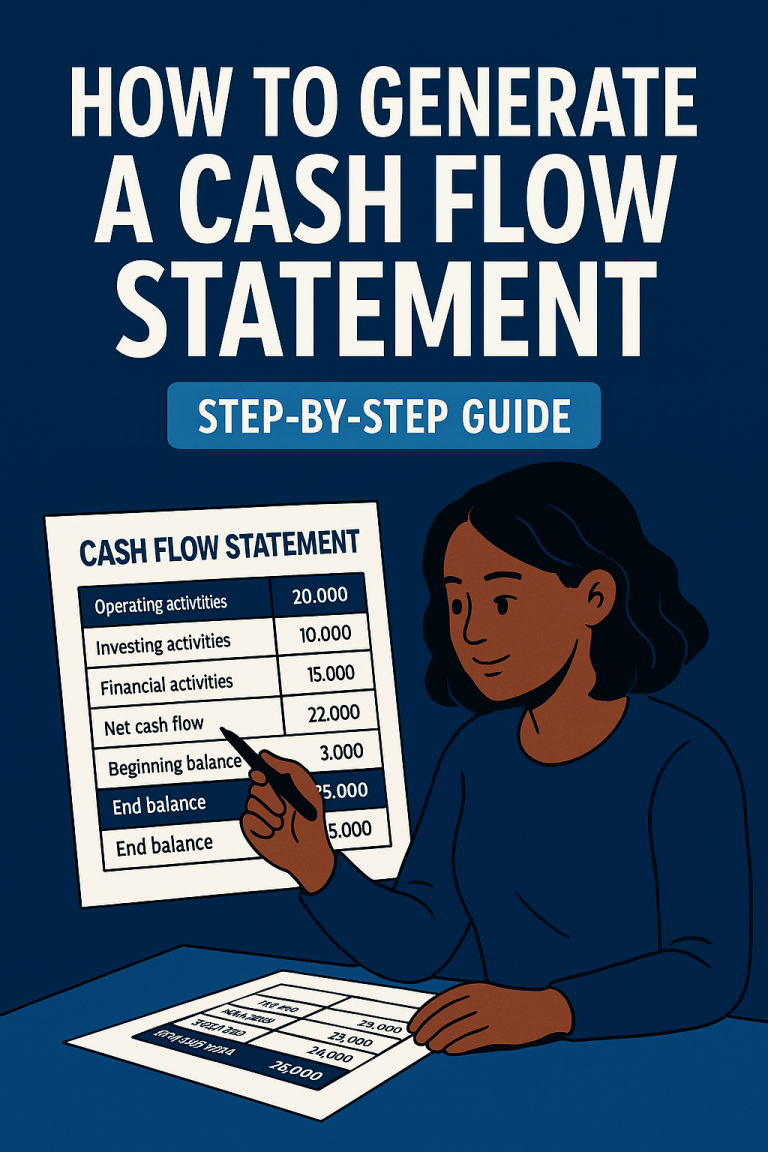
How To Generate A Cashflow Statement – Step-by-Step Guide
Table of Contents
One of the key challenges for small businesses is financial management, encompassing accounting and effective money management to prevent bankruptcy.
Effective money management is a key aspect of running any business. With a cash flow statement, entrepreneurs get to track the money coming in (profit, revenue) and the money going out ( expenditure) and how much the business is growing or expanding.
What Is A Cash Flow Statement
A cash flow statement is a financial document that explains how cash comes in and goes out of a business over a particular period of time. The cash flow statements focus only on transactions, unlike the income statement or the balance sheet.
A cash flow statement includes operating activities, which have to do with everyday business transactions; investing activities, such as the buying of equipment or property; and financial activities, like loans.
The Importance Of A Cashflow Statement To Small Businesses
A cash flow statement plays a significant role in small businesses and other businesses. It helps companies to keep track of their day-to-day business transactions. The importance of this statement includes.
- It helps build trust between business owners, banks and investors
- It helps businesses keep track of the purchases made and when it was made
- It helps business owners pay their workers on time
- It helps companies to scale faster
- It helps businesses prepare for financial investments
How to Write A Cash Flow Statement For Your Business
Step One: Choose A Time Frame:
The time frame can be monthly, quarterly, or weekly, depending on how you want to start. For instance, when you need a statement of account from a bank, you specify if it is for the last year, months, etc. In the same way, you need to specify the period for which you want to do a cash flow for your business.
Step Two: Get All The Cash Inflow:
You need to get all the cash that came in during the period of time you chose initially. Get the cash inflow and document it
Step Three: Get The Cash Out Flow
This refers to all the cash that went out from the business, whether it was used to purchase something or pay bills. Get the cash flow and document it
Step Four: Organise the Two Cash Flows.
First, you need to break down each cash flow into investing activities, operating activities, and financial activities to determine where each one belongs.
Step Five: Calculate The Net Cash Flow.
Here, you need to add everything together and subtract to get the net cash flow. It includes Total cash inflow – Total cash outflow = Net cash flow
Step Six: Add the beginning balance to the initial balance to get the final balance
To reduce the ambiguity of this, it’s advisable to get a cash flow statement every month, depending on the size of the business.
Here is an example
| Money flow | Total Inflow | Total outflow |
| Operating activities | 20,000 | 10,000 |
| Investing activities | 8,000 | 1,000 |
| Financial activities | 15,000. Total = 43,000 | 10,000. Total = 21000 |
| Net cash flow | 43,000 – 21,000 =22,000 | |
| Beginning balance | 3,000 | |
| End balance | 25,000 |
To manage your cash flow effectively, you need to be conscious of how much comes in and how much goes out of your business in terms of operating activities, investing activities, and financial activities. It is also important to keep receipts after any transaction.
You Might Have Questions Like
What Is The Difference Between The Cash Flow Statement And Profit
A cash flow statement is a document that helps businesses track how money comes in and goes out of a business in its day-to-day activities. On the other hand, the profit is the gain a business is left with after calculating the total expenses and costs. This could be gross profit or net profit
What Should I Use To Create A Cash Flow Statement For My Business
To create a cash flow statement, you can use Google Spreadsheet or any spreadsheet template
How Often Should I Generate My Cash Statement
It is advisable to generate a cash flow document on a monthly basis to prevent ambiguity
Conclusion
When you don’t track where and how you spend your money, you might end up spending money on irrelevant things or investing it in the wrong area of your business.
This is why you need to generate a cash flow statement for your business frequently, to be able to track your business spending and correct any impulsive spending.